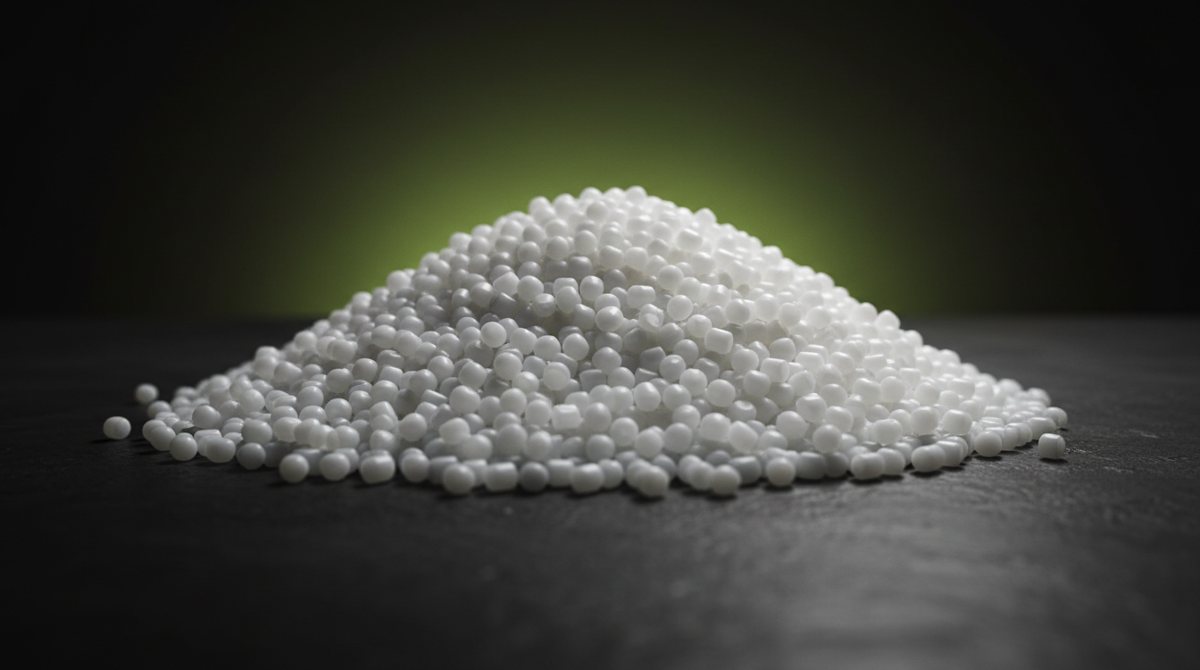
What is white masterbatch?
White masterbatch is a concentrate with a high loading of titanium dioxide (TiO₂) dispersed in a carrier polymer. It gives plastics opacity, whiteness and gloss, and is also used to lighten the base shade of colored products. Together with filler and black masterbatch, it is one of the three core items of Erk-Han's export range.
Why rutile TiO₂?
TiO₂ is sold in two crystal forms: anatase and rutile. Rutile has the higher refractive index (about 2.73), so the same opacity is reached with less pigment. Anatase is photocatalytic under UV light and can speed up chalking and yellowing of the polymer. That is why our white masterbatches use rutile TiO₂.
Dispersion supported by calcite
Some of our formulations contain micronized calcite (CaCO₃) alongside the TiO₂. The fine calcite particles sit between the TiO₂ particles and reduce agglomeration, so the pigment disperses more evenly in the melt and gives higher opacity at the same ratio.
Concentration options
- 40% - 50% rutile TiO₂: A balanced choice between cost and opacity for injection molding and general plastics applications.
- 60% - 70% rutile TiO₂: A concentrated formulation for thin films and applications that need maximum opacity.
Food contact applications
If the product will be used in an application that touches food, such as packaging or kitchenware, please say so in your quotation request. We will select the right series together, based on the regulations of your target market (for example EU 10/2011 and REACH in the EU). On request, we provide our raw material suppliers' FDA 21 CFR compliance declarations together with an Erk-Han declaration of compliance.
Documents and quotations
A TDS and an MSDS are provided for every series, and each shipment comes with a certificate of analysis (CoA). We ship from our plant in Bursa OSB via Gemlik Port to Europe, Africa and the Americas. For samples and prices, request a quotation.