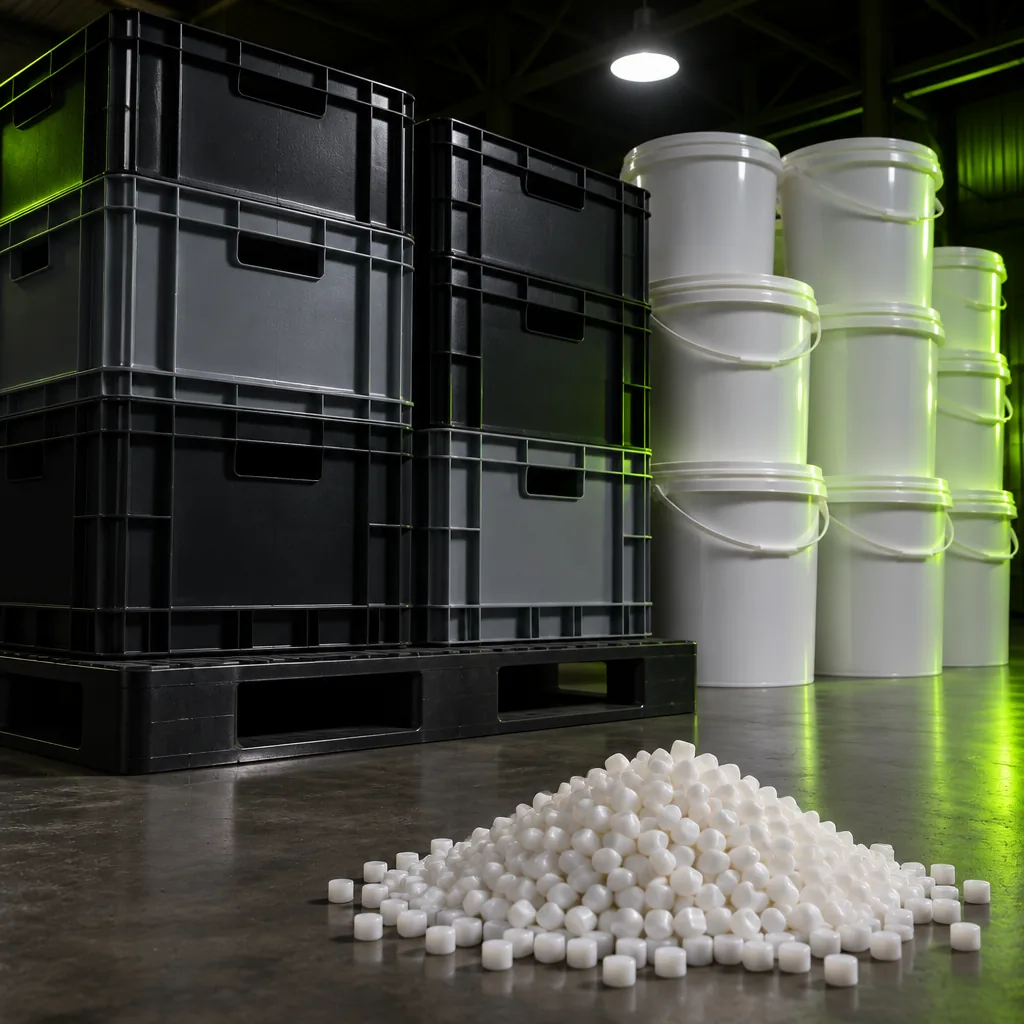
Food buckets (yogurt, cheese, pickles, ice cream, olives), industrial paint and construction chemical buckets, agricultural and cold storage crates, heavy-duty pallets, automotive KLT logistics containers and waste containers face some of the toughest mechanical, thermal and hygienic tests in the plastic injection industry. A thin-walled IML yogurt bucket demands cycle times measured in seconds and complete leakproofness, while a 20-kilogram paint bucket must withstand drops from meters high, resist collapse under stacking loads 8–10 high and resist chemical cracking.
Drawing on the expertise in polymer physics and rheology gained since 2006 by our group company Colorex, Erk-Han produces masterbatch and functional additive systems tailored to every process, from high-speed thin-wall injection to high-tonnage pallet and crate molds, that do not cause warpage (low-warpage), preserve cold impact strength, are fully compatible with food contact and deliver zero shade deviation in every lot.
Explore all our product groups on the Erk-Han homepage.
The Polymer Science of Crate, Bucket and Pallet Production (Engineering Fundamentals)
Field failures in crate and bucket production (lids that do not close, cracked bucket rims, brittle fracture in the cold, collapse in the stack) are rooted directly in polymer physics and crystal morphology. Erk-Han formulations are designed around the following 5 fundamental scientific principles:
1. Crystallization Kinetics and Anisotropic Shrinkage (The Physics of Warpage)
Polypropylene (PP) and high-density polyethylene (HDPE) are semi-crystalline polymers; as they pass from melt to solid they shrink by forming ordered crystalline regions (spherulites). Many standard organic pigments (in particular certain copper phthalocyanine blues/greens and some azo red/yellow types) act as uncontrolled heterogeneous nucleating agents in the melt. This widens the difference (anisotropy) between the shrinkage ratio in the flow direction (S∥) and the shrinkage ratio perpendicular to the flow (S⊥), leading to ovality distortion of bucket lids, loss of sealing and severe warpage of flat crate/pallet walls. For large and lidded molds, Erk-Han uses low-warpage pigment architectures with minimized nucleation effect.
2. Glass Transition Temperature (Tg) and Ductile-Brittle Transition (The Physics of Cold Impact)
The fundamental physical boundary that determines whether a plastic yields under impact (ductile) or shatters like glass (brittle) is the glass transition temperature (Tg). The Tg of standard homopolymer PP is around 0°C; when the ambient temperature drops below this threshold (for example in winter transport or a -20°C cold store), the segmental motion of the polymer chains freezes and the material switches to sudden fracture. HDPE, with a Tg of about -110°C, is naturally more resistant to cold, but an incompatible carrier or poor pigment dispersion creates a microscopic notch effect (stress concentration) that dramatically reduces impact resistance. Using carriers fully compatible with the polymer and POE elastomer systems with a very low Tg, Erk-Han activates cavitation and shear yielding mechanisms to dissipate impact energy safely.
3. Viscoelastic Creep and Long-Term Stacking Strength
Plastics are viscoelastic materials; when a constant load is applied to them for a long time (for example paint or pickle buckets stacked 8 high in a warehouse), they show time-dependent permanent deformation (creep) even if they remain below the elastic limit. In hot summer warehouses (35–45°C) the flexural modulus (E) of the polymer drops, and the buckets in the bottom row can buckle and topple. Low-cost masterbatches with a weak carrier resin or excessive plasticizer/wax accelerate the creep rate. Erk-Han formulations are developed with high-molecular-weight carriers that preserve the crystalline rigidity and long-term stacking resistance of the base polymer.
4. Environmental Stress Crack Resistance (ESCR) and Tie Chains
In buckets containing paint, thinner emulsions, agrochemicals, liquid detergents and oils, surface-active chemicals weaken the tie molecules (tie chains) that link the crystalline lamellae of a semi-crystalline polymer, causing slow crack growth (ESCR) even under low stress. Undispersed coarse pigment or filler clusters (agglomerates) in the masterbatch act as initial flaws according to Griffith crack mechanics. Erk-Han’s high-shear dispersion technology eliminates these stress concentrators and secures the ESCR life of buckets and jerrycans.
5. Optical Opacity (Mie Scattering) and the Physics of Food Migration (Fick Diffusion)
In a thin-walled (0.4–0.8 mm) white food bucket, maximum opacity is essential so that the contents are not exposed to light and do not spoil. In optical physics, maximum light scattering (Mie scattering) depends on a high refractive index difference between pigment and polymer (n(rutile TiO₂) ≈ 2.73 and n(PP/PE) ≈ 1.50) and on homogeneous dispersion of TiO₂ particles with a diameter around half the wavelength of visible light (0.20–0.30 µm). At the same time, in food contact the transfer of small molecules from the polymer matrix into food is governed by Fick’s laws of diffusion; Erk-Han food-grade formulations use high-molecular-weight, non-migrating components to provide safe protection well below the EU 10/2011 overall migration limit (10 mg/dm²).
Erk-Han Solutions by Crate, Bucket and Logistics Product Group
1. Food Buckets and Thin-Walled IML Packaging (Yogurt, Cheese, Pickles, Ice Cream, Olives)
- Full Food Contact ComplianceSafe pigment and carrier systems that comply with EU 10/2011 and Turkish Food Codex criteria, contain no heavy metals, and cause no odor, taste or color transfer (migration) into fatty/acidic foods (olive oil, pickle brine, milk fat).
- High Opacity and Light BarrierErk-Han White Masterbatches with a high rutile TiO₂ loading that prevent light-induced oxidation (rancidity) of dairy and fat-based foods even at wall thicknesses below 0.5 mm.
- High-Speed Thin-Wall Injection (High MFI)Clean formulations compatible with high-flow PP copolymers/homopolymers in the MFI 35–70 range that cause no flow marks or gate blush at the mold gate and do not impair IML label adhesion.
2. Paint, Construction Chemicals, Lubricant and Industrial Buckets
- Drop Test and UN PerformanceHighly dispersed color and white masterbatches that preserve the impact strength of the polymer, ensuring that the bucket base and handle attachment points do not crack in drop tests at a filled weight of 15–25 kg.
- Lid Sealing and Low Warpage (Low-Warpage)Special pigment selection that does not trigger warpage and keeps the bucket body and lid in a perfectly circular fit (ovality close to zero).
- Corporate Brand Color ConsistencySpectrophotometric ΔE < 1.0 precision in the corporate Pantone/RAL colors of major paint and lubricant brands, across production batches and in lid-to-body matching.
3. Agriculture, Fruit & Vegetable, Meat, Fish, Bread and Cold Storage Crates
- Cold (-20 °C / -40 °C) Impact ProtectionCarriers compatible with HDPE and impact-resistant PP, together with POE-based Erk-Han Impact Modifier solutions, that prevent breakage in deep-freeze and cold-chain logistics.
- Stable Color with Regrind / PCR and High CalciteHigh-hiding black, blue, green, yellow and red masterbatches that cover the graying and fluctuations in the base color of regrind HDPE/PP raw materials widely used in agricultural and market crates.
- Outdoor UV ProtectionHALS UV stabilizer combinations that prevent embrittlement and fading of crates left under the sun in open fields and on transport trucks during harvest.
4. Heavy-Duty Pallets, Automotive KLT Containers and Municipal Waste Containers
- Forklift and Mechanical Impact ResistanceFormulations that do not weaken the polymer chain and withstand heavy impact, lifting loads and environmental stress in heavy pallets molded on very high-tonnage machines and in 120–1100 liter waste containers.
- ESD / Antistatic KLT Logistics ContainersAntistatic solutions that prevent dust pick-up, or conductive black masterbatch solutions that protect electronic boards from static discharge, for transport containers used in automotive and electronics plants.
- High UV and Odor/Rodent ProtectionStrong UV packages for outdoor sun resistance in municipal waste containers, high-opacity green/blue/anthracite/yellow colors and, on request, rodent repellent/odor eliminating additive support.
5. Housewares, Storage Containers and Laundry/Cleaning Buckets
- High Gloss and Vivid Pastel/Trend ColorsHigh surface gloss, modern pastel shades, pearlescent/marble effects and resistance to dishwasher hot water/detergent for kitchen storage containers, laundry baskets and bathroom sets.
Performance-Enhancing Erk-Han Additive Solutions for Crate and Bucket Production
- Impact Modifier and Compatibilizer MasterbatchBinds mixed PP+PE regrind raw materials into a single phase; improves the cold and drop test performance of high-calcite or homopolymer crates and buckets.
- Mold Release MasterbatchEliminates the need for external spray in deep-draw paint/food buckets and multi-cavity crate molds, prevents ejector marks and shortens cycle time by 5–15% (with silicone-free options compatible with IML and printing).
- Antistatic (Dust-Repellent) MasterbatchPrevents stored white food and paint buckets from attracting dust/dirt through static electricity on the shelf and during transport; reduces static-induced label shifting on IML labeling lines.
- UV & Light StabilizerPrevents sun-induced chalking and cracking of agricultural crates, waste containers, pallets and outdoor buckets stored in open yards.
- Desiccant and Odor Eliminating MasterbatchEliminates moisture-induced surface bubbles and unpleasant plastic odor in economical crates made with regrind and PCR raw materials.
- Foaming MasterbatchPrevents sink marks and warpage in thick-walled heavy pallets and thick-ribbed crates, and saves 10–15% of raw material in part weight.
- Machine and Screw Cleaner (Purging Compound)Cuts transition losses and downtime by more than half when changing from dark colors to white/transparent on crate and bucket injection machines with frequent color changes.
Common Field Problems in Crate and Bucket Production and Their Scientific Solutions
- ProblemBucket Lids That Do Not Close, Leakage and Ovality Distortion (Warpage)
- Scientific Root Cause: The organic pigment used causes directional nucleation in semi-crystalline PP/HDPE, creating an anisotropic shrinkage difference between the flow direction and the transverse direction.
- Erk-Han Solution: Selection of low-warpage pigments with a nucleation coefficient close to zero and controlled carrier rheology.
- ProblemBucket/Crate Breakage in the Drop Test or in Cold Weather
- Scientific Root Cause: The glass transition temperature (Tg) of homopolymer PP around 0°C, an incompatible masterbatch carrier, micro stress concentrators created by poor pigment dispersion, or PP/PE phase separation in regrind material.
- Erk-Han Solution: Highly dispersed masterbatches with carriers fully compatible with the polymer, and support from the low-Tg, POE-based Erk-Han Impact Modifier / Compatibilizer.
- ProblemLight Transmission and High Dosage Cost in Thin-Walled Food Buckets
- Scientific Root Cause: A reduced refractive index difference and lower Mie scattering efficiency in white masterbatches containing low-grade TiO₂ or excessive calcite.
- Erk-Han Solution: Maximum opacity at low dosage with Erk-Han White Masterbatch based on high-concentration rutile TiO₂ with optimum particle size (0.20–0.30 µm).
- ProblemBase/Corner Cracking Over Time in Chemical or Detergent Buckets (ESCR)
- Scientific Root Cause: Surface-active chemicals weakening the polymer tie chains, and coarse pigment/filler clusters forming crack initiation points.
- Erk-Han Solution: Homogeneous dispersion with low FPV, clean carrier selection and polymer compatibility that supports ESCR.
- ProblemSticking, Ejector Whitening and Slow Cycles in Deep Bucket and Crate Molds
- Scientific Root Cause: The polymer clamping onto the male core with a high normal force as it shrinks on cooling, and a rise in the static friction coefficient.
- Erk-Han Solution: Low ejection force, mark-free demolding and shorter cycle time with silicone-free Erk-Han Mold Release Masterbatch compatible with IML and printing.
Supported Polymers and Production Processes
- PolymersPP block copolymer (ICP), PP random copolymer (RCP), PP homopolymer, high-flow thin-wall PP (MFI 25–70), injection-grade HDPE (MFI 4–20), LDPE/LLDPE (flexible lids), recycled (PCR/PIR) PP and HDPE, calcite/talc-filled polyolefins.
- ProcessesHigh-speed thin-wall injection (including IML), high-tonnage standard and multi-cavity injection molding, hot runner systems and blow-molded containers.
Erk-Han Laboratory Tests Specific to the Crate and Bucket Industry
- Spectrophotometric ΔE and Opacity (Contrast Ratio) MeasurementNumerical verification of target opacity in thin-walled buckets and zero-metamerism control between body and lid under different light sources.
- Izod / Charpy Impact and Tensile-Elongation Tests (ISO 179 / ISO 180)Measurement of the balance between impact energy and flexural modulus at room temperature and at low temperatures.
- MFI / MVR (ISO 1133) and Thermal Stability AnalysisVerification of flow balance in thin-wall high-speed molds and of color stability at high injection temperatures.
- FPV (Filter Pressure Value) and Ash Furnace AnalysisHomogeneous dispersion that does not clog screens/hot runners, and a guaranteed exact TiO₂/pigment/filler ratio in every production lot.
- Food Compliance and Regulatory VerificationDocumentation for EU 10/2011, FDA, REACH, RoHS and heavy-metal-free content.